
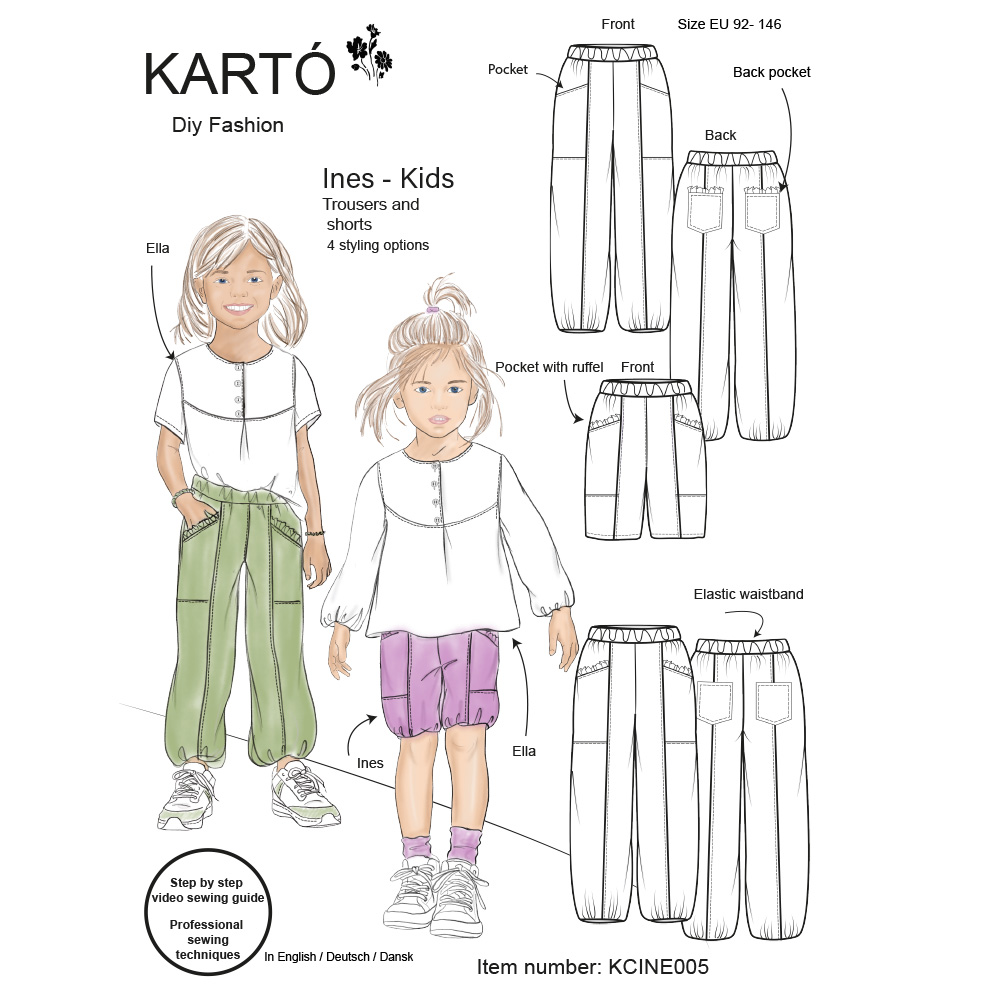
Access to Your Video Sewing Tutorial
You need a password to access your video sewing tutorial.
Your password is printed on the pattern and is unique to you.
If you have any questions, you are always welcome to contact us at sewing@karto.dk
1. What you need for the trousers.
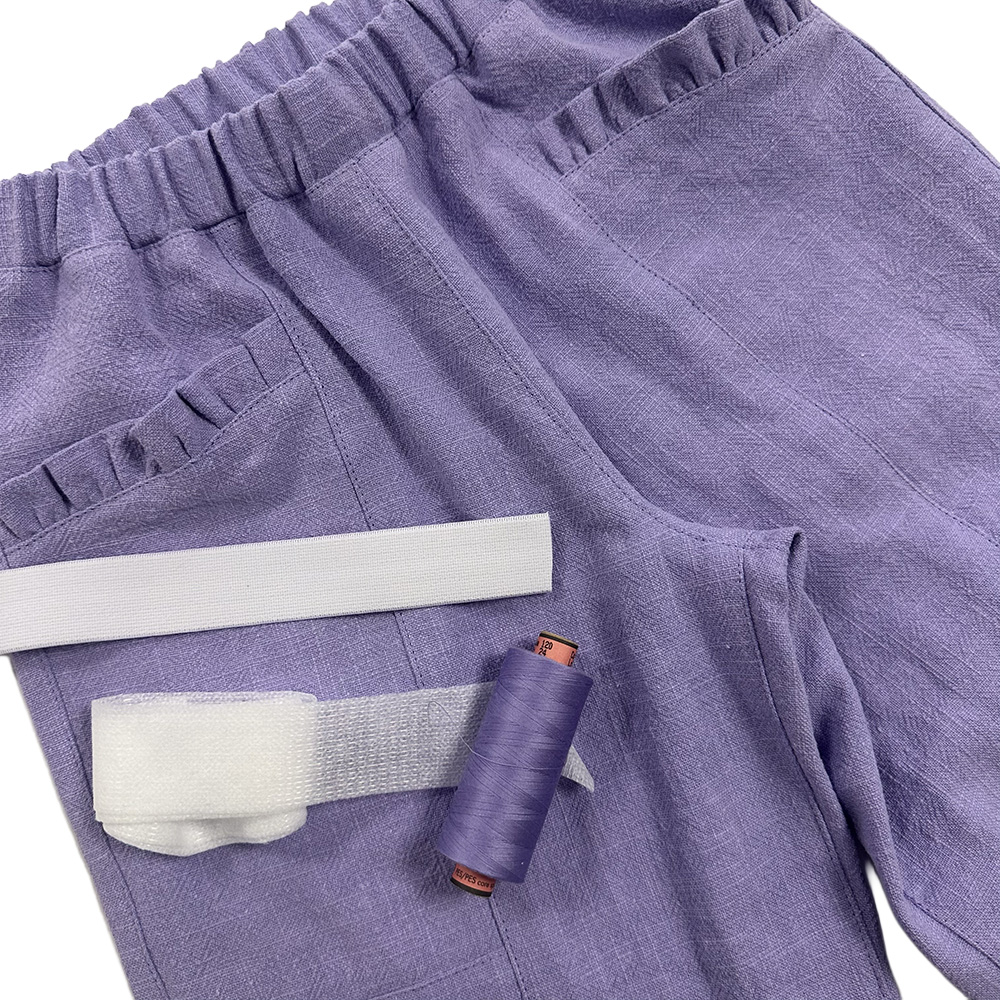
You will need for the Ines trousers
-
50cm fusible tape with reinforcement threads, 3 cm wide
-
2.5 cm wide elastic band
How to press the interfacing tape:
Place the tape on the wrong side of the outer fabric with the adhesive side facing down. Cover with a damp cloth and press with the iron for about 12 seconds – without sliding. You can also use the steam function.
2. Your pattern includes a 1 cm seam allowance.
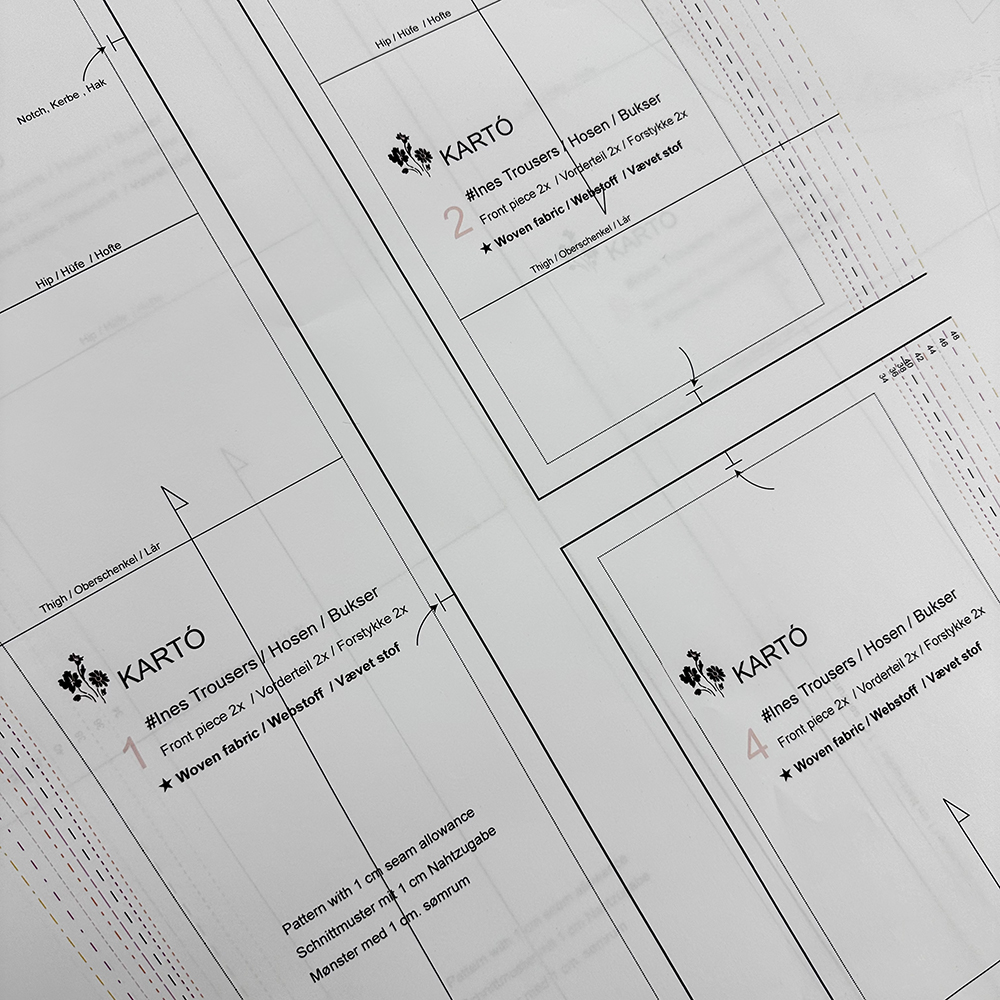
Seam allowance.
Your pattern includes 1 cm seam allowance
Grainline.
The grainline is important. The arrow on the pattern piece must always be parallel to the selvage to ensure correct placement on the fabric.
Notches.
Remember to cut the small notches according to the markings on the pattern pieces.
Stitch length.
Sew the blouse together with a stitch length of 2.5 (9 stitches per 2 cm).
For topstitching, use a stitch length of 3.
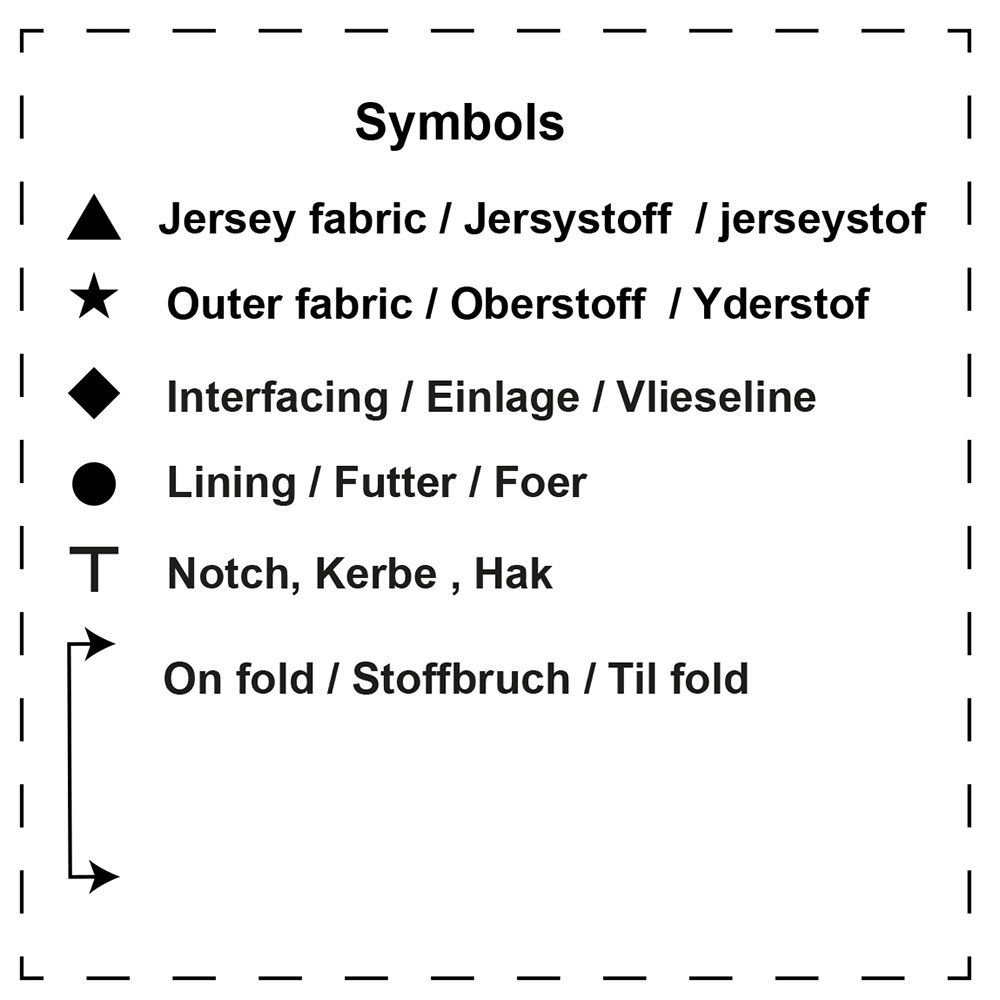
Explanation of symbols in the pattern
In this pattern, different symbols are used to clearly indicate which pieces should be cut in fabric, lining, and interfacing.
There is also a symbol showing which pattern pieces should be placed on the fold of the fabric, as well as notches that help you align the pieces correctly.
Follow the symbols carefully for the best result.
3. Cutting layout
- Front piece 2x
- Front piece 2x
3A. Front piece / Pocket 2x
3B. Front piece / Pocket with ruffle 2x - Front piece 2x
- Back piece 2x
- Back piece 2x
- Back waistband 1x
- Back waistband 1x
- Back pocket 2x
- Ruffle 4x
That’s why we sew topstitching…
Topstitching has both a practical and a visual function.
It keeps the seam allowance in place and gives a neat, professional finish.
At the same time, it helps shape the design expression – you can choose thread colour and placement depending on the look you want. Sew close to the edge for a discreet finish or with a little distance for a more striking effect.
4A. Sew the pockets onto the front piece
4B. Sew the pocket with ruffel
5. Sew the front pieces together
6. Sew the back pieces
7A. Sew the back pockets
7B. Sew the back pocket with ruffel
8. Sew the back pocket onto the back piece
Pocket placement
I placed the back pocket approx. 7.5 cm below the waist edge in size 110. Use this as a guideline and adjust the placement so it suits the size you are sewing. The back pocket can be placed wherever you prefer—it’s a design detail you can customise.
9. Sew the side seams
10. Sew the inside leg seams
11. Sew the crotch seam
12. Sew the waistband
13. Hemming